There are hardly any business leaders left who are unaware that cybersecurity is important.
Most have heard the stories about ransomware, phishing, and companies losing access to their systems or data. Many have also experienced smaller incidents themselves along the way — suspicious emails, compromised passwords, or employees accidentally clicking on something they should not have.
The problem is therefore rarely a lack of awareness. Most companies already know that cybersecurity is something they should take seriously.
Even so, it often becomes an area that gradually slips further down the priority list.
This is not necessarily due to indifference. In many cases, it is simply a reflection of what everyday life in a modern business actually looks like. When the natural focus is on customers, operations, employees, finances, and delivering work, security efforts can quickly become something handled gradually in small portions whenever time allows.
As a result, many companies are already doing various things to improve security without necessarily approaching it as part of a unified strategy. Perhaps antivirus software has been installed. Perhaps backups exist. Some employees may use multi-factor authentication, while others still do not. Access permissions may have evolved over many years without ever being reviewed as a whole.
This is rarely the result of irresponsibility. On the contrary, it often develops naturally in companies that grow and evolve over time. New systems are introduced, employees join and leave, and different solutions are added along the way as needs change.
At some point, it becomes difficult to maintain a full overview.
One of the most challenging aspects of cybersecurity is that problems are rarely obvious until something goes wrong. If everything appears to function normally, it can be difficult to assess how significant the risks actually are and which areas deserve the most attention.
At the same time, many companies experience the security field as becoming highly technical very quickly. There is an overwhelming number of recommendations, standards, and products available, and it can be difficult to determine what is actually relevant for a specific business.
That is one of the reasons why we at ITGuy find tools like Cybercue interesting.
The goal is not to turn companies into security experts or to create yet another large IT project. What makes it valuable is the idea of making cybersecurity more manageable and practical to work with in everyday business operations.
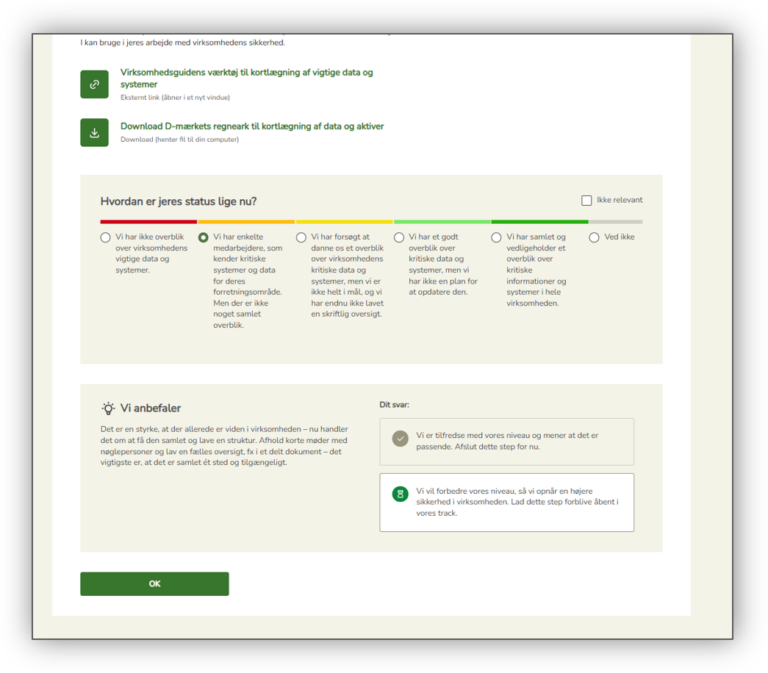
Cybercue helps companies build a more structured understanding of their current security level and identifies areas where improvements make the most sense first. Instead of trying to solve everything at once, the work is divided into smaller and more manageable steps.
For many companies, that type of structure is exactly what has been missing in order to move forward.
When security work feels overwhelming, it becomes easy to postpone. Not because it is unimportant, but because it can be difficult to find a natural place to begin. As a result, even relatively simple improvements can end up being delayed for months or years.
In practice, however, good cybersecurity is often less about perfection and more about gradually reducing risk, building better habits, and gaining better insight into how the company actually works with access, data, and systems.
Many small improvements can together make a significant difference over time.
This is especially true for small and medium-sized businesses, where resources are rarely unlimited and where security efforts must realistically coexist with day-to-day operations.
Cybersecurity may therefore be less about reaching a specific level and more about working systematically with the area over time. Not necessarily perfectly, but consciously and structured enough to ensure that important things are not forgotten or overlooked.